Summary
Sugar is a community-focused food marketplace designed to reduce food waste by making it easy to post, browse, and exchange surplus food locally, while building trust through safety-forward product decisions.
My Role
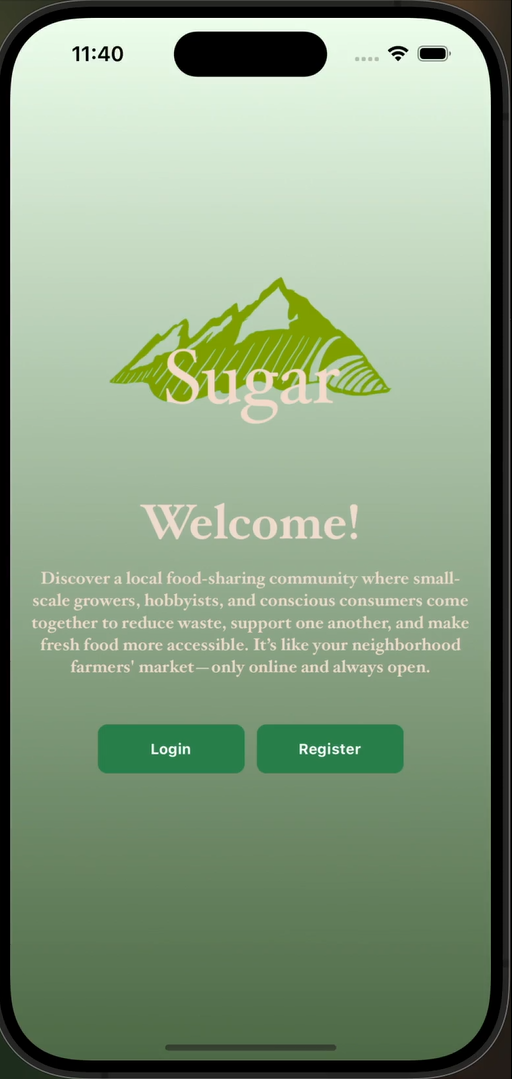
I led key parts of the product’s visual identity and UI design, including the logo, color system, and onboarding screens (welcome, login, and related flows). I also contributed to frontend implementation to ensure the final build matched the design intent.
The Challenge
Our research showed that trust and food safety are major barriers to food sharing. The challenge was designing a marketplace that feels safe and convenient enough for real adoption, while still supporting the project’s goal of reducing food waste.
Business + product strategy
Sugar’s strategy centers on reducing waste while respecting the real concerns users have about food safety and reliability. We explored a tiered marketplace model that supports multiple sources of surplus food, including peer-to-peer listings and trusted providers.
Key research insights
- Trust is essential: people prefer sharing or buying from sources they feel are safe and vetted.
- Affordability + convenience drive adoption: users want low-friction workflows and clear value.
- Reducing waste is motivating: many users want to sell or share food before it expires.
- Feature opportunities: ratings/verification, ingredient filtering, and food tracking to prevent waste.
Key product decisions
- Trust & safety: rating/verification mechanisms to support safer exchanges.
- Food tracking: help users identify items likely to go to waste and suggest actions.
- Marketplace tiers: expand beyond “leftovers” to include trusted/professional sources and amateur sellers.
Brand + UI design
I focused on creating a visual system that feels modern, friendly, and trustworthy. My design work included the app’s logo, color palette, and onboarding experience (welcome/login), with an emphasis on readability and approachable interactions.
Design goals
- Signal trust through clean hierarchy, predictable patterns, and clear labels.
- Support quick posting and browsing so the product feels effortless.
- Keep the UI inclusive with strong contrast and legible typography.
My contributions
- Logo + core branding
- Color scheme + UI consistency
- Welcome + login flows
- Frontend implementation support
MVP features
The MVP supports core marketplace behaviors: browsing listings, viewing details, and interacting with items in a way that is scalable to future checkout or messaging features.
- Marketplace browsing: view “Free” and paid items, sorted by recency.
- Item detail modal: see description, origin, certifications, expiry, and location (when shared).
- Extensibility: design supports future checkout, messaging, and seller contact flows.
Tech stack
- Frontend: React Native + Expo + TypeScript
- Backend: Node.js + Express
- Database: MongoDB Atlas
- Auth: JWT
- UI: React Native Paper
- Forms: Formik + Yup
- CI/CD: GitHub Actions
Project artifacts
These artifacts capture the business strategy, research insights, and final design + implementation.
- Business & research: empathy interviews and investor update (insights + product direction).
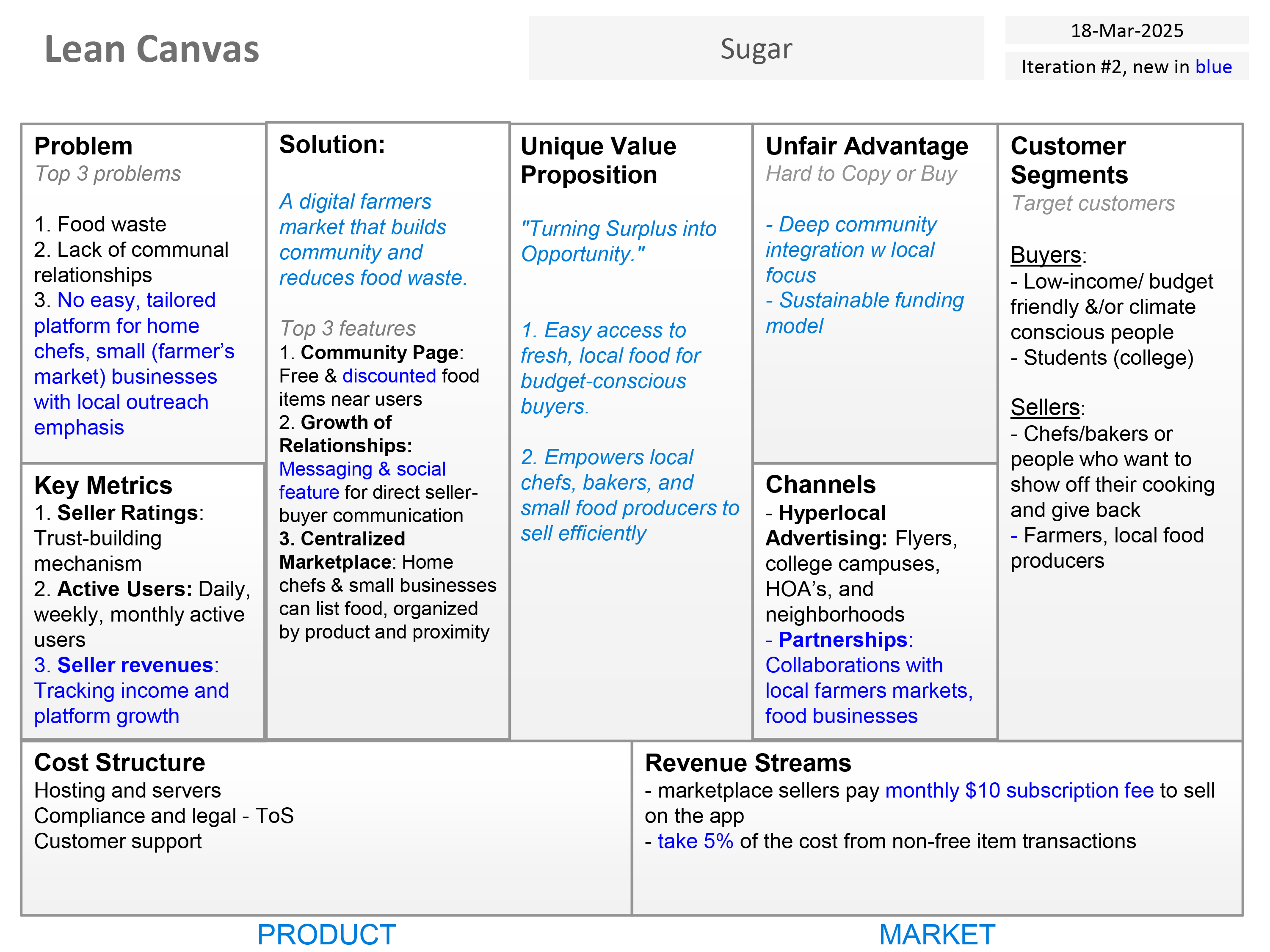
- Planning: lean canvas and pitch materials (value proposition and MVP definition).
- Design: final Figma prototype (end-to-end flows).
- Implementation: GitHub repository (React Native app + backend API + setup docs).
Links
View the prototype and codebase for full details.
Reflection
What I learned
This project strengthened my ability to connect user research to product decisions and express those choices through a cohesive visual system. It also helped me translate design into implementation by collaborating on frontend work and validating the build against the prototype.
Next improvements
- Expand trust mechanisms (verification, ratings, clearer sourcing)
- Improve food tracking and “use before it expires” suggestions
- Add messaging/checkout workflows with clear safety guidance
- Continue accessibility checks (contrast, focus states, reduced motion)