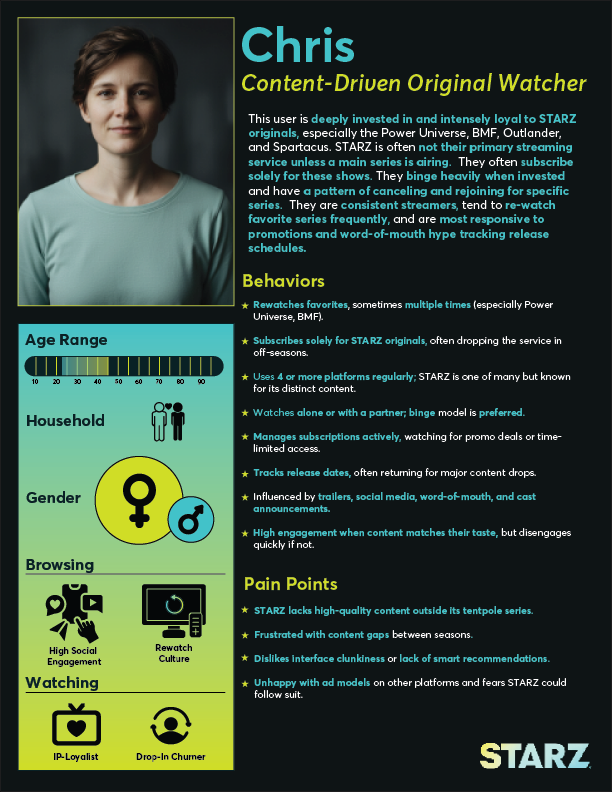
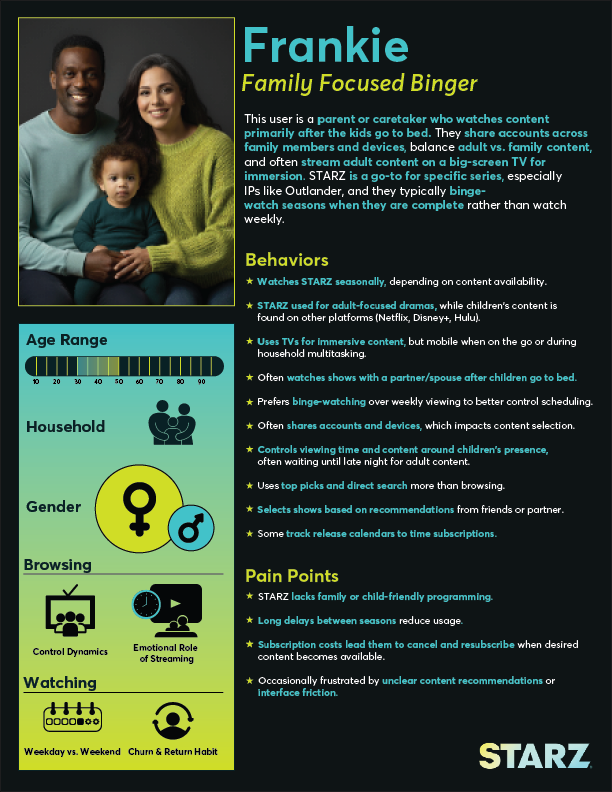
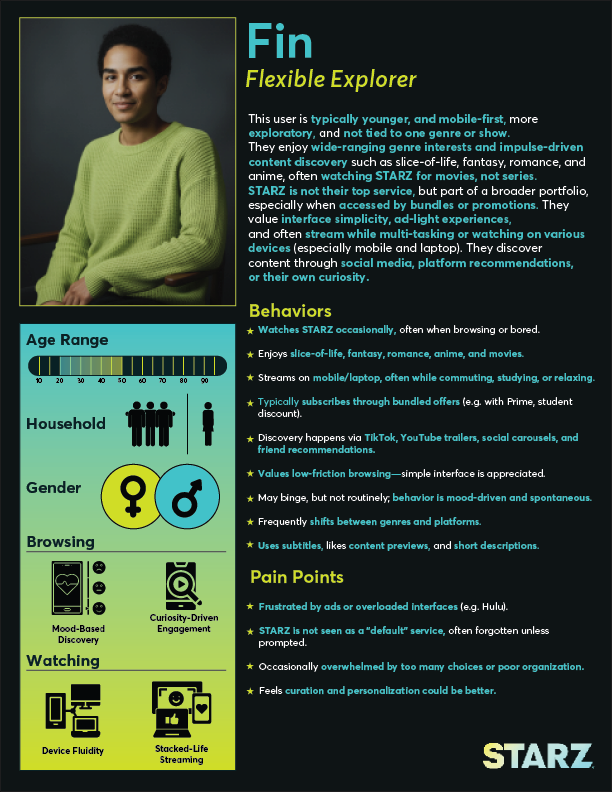
Summary
The goal was to establish a clearer, shared understanding of STARZ users beyond individual shows: how they choose content, when and where they watch, and what drives retention vs. churn. I combined screening, moderated research, and survey-based inputs to identify patterns and validate three core personas that STARZ could use as a long-term framework for product and content decisions.
Outcome: Three validated personas with observed differences in motivation, viewing habits, and pain points; used to inform future strategy.
My Role
I led the research execution and synthesis, translating stakeholder questions into a structured plan and consistent question set that could be used across participants without bias.
- Built pre-screening questions in Qualtrics to support recruiting
- Managed participant screener & scheduling via User Interviews
- Conducted moderated usability interviews and captured follow-ups in UserZoom
- Documented sessions, synthesized themes, and produced a clear report for stakeholders
- Incorporated (non-shareable) inputs from internal teams to shape what to look for, while keeping personas focused on people, not individual STARZ titles
The Challenge
Timing and experience constraints shaped this work. I had about five weeks remaining at STARZ while also completing the Title Art research I’d already committed to. I had never created a persona before, and had to learn what personas are, how to build them responsibly, and how to synthesize data quickly.
Another challenge was encouraging richer stories about app usage while staying consistent and fair across participants (avoiding one-off questions that others didn’t receive). Support from my mentor and manager, Leslie Salazar-Bushell, was critical as I built the skills and confidence to do the work well.
Study approach
Method & tools
- Pre-screen: Qualtrics
- Recruiting & scheduling: User Interviews
- Sessions: Moderated usability interviews + follow-up questions captured in UserZoom
- Outputs: Documentation, synthesis, and a persona framework delivered to stakeholders
What I was trying to learn
- Viewing behaviors and motivations (why users come to STARZ and what keeps them)
- Discovery patterns (how users find content and what “good recommendations” mean to them)
- Subscription habits (churn/return triggers, promo behavior, device/account management)
- Pain points that block engagement (friction, overwhelm, unclear organization)
Key result
The research validated three core personas (used later to create the posters shown above):
- Flexible Explorer (40.2%)
- Content-Driven Original Watchers (38.1%)
- Family-Focused Binger (21.7%)
Percentages from internship presentation materials.
Question development artifact
To keep the research structured and consistent, I gathered stakeholder questions and my own prompts, then synthesized them into themes and a reusable interview guide. The FigJam also documents my timeline constraints, early notes, and how the moderated session questions evolved.
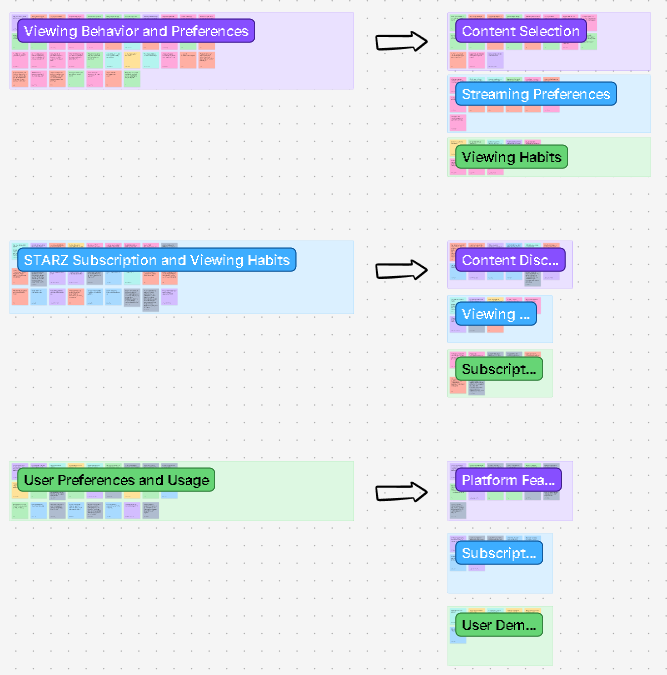
Click image to enlarge.
View the full board
The board shows the thinking behind the research questions and how themes were organized.
Open FigJamWhat stakeholders gained
A shared language for user needs
The personas provided a concrete way to discuss “who we’re building for” across product and UX: grounded in behaviors, motivations, and pain points rather than individual shows or campaigns.
A framework that outlives a single project
Even when a team can’t act on every insight immediately, foundational research becomes a reference point for future tradeoffs, roadmaps, and messaging.
Reflection
Research takes time to run and even more time to synthesize. I would have loved additional time to visualize the personas myself, but when I realized I couldn’t, I asked my manager not to let the research die. We stayed in touch after I left STARZ, and the three personas were later visualized and put up in the office. The result reinforced a key lesson for me: research remains valuable even when stakeholders can’t use all findings immediately, because the same evidence may become the deciding input later.
Stakeholder feedback
“She completed 6 research projects, including a large foundational project in which she defined 3 user personas based on marketing data and 3 rounds of user interviews.”
— Leslie Salazar-Bushell